Böncast: His Eminence, Menri Ponlob Interview
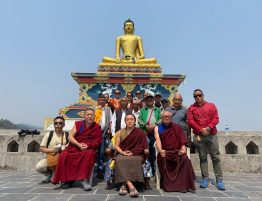
This interview with His Eminence, Menri Ponlob, Trinley Nyima Rinpoche, was conducted by Nick T. in September of 2026. The interview occurred during the period of the monastery performing the Sidpai Gyalmo Bum Tsog, and during a teaching of Yidam Phurpa given by His Holiness, the 34th Menri Trizin. The interview was translated into English by Latri Nyima Dakpa Rinpoche.
Listen to the full Böncast here:
https://doortobon.org/boncast-bon-podcast/
Yeru:
Oh, thank you so much, Your Eminence, for speaking with me. I really appreciate it, it’s very kind.
H.E.:
Oh yeah, tug je che, thank you.
Yeru:
When you are teaching a student, how can you tell when they move from intellectual understanding to real experience or realization?
H.E.:
So, normally it is important that you have to go through the process of listening and thinking and meditating—meditation.
So if you keep continuing this for long enough time, individually, your own self will also realize or feel where you are at. And also, as a teacher, if [we] look and check the way you ask questions, the way you explain, the way you behave, in many things—everything is very much kind of symbolic that [we] also can check.
But mostly it’s your (the practitioner’s) own feeling of comfortableness and thinking, “I’m this,” or “I’m that level.” So, carry it on in everyday life, that it will put you to a state of where you are aware.
Yeru:
Thank you, tug je che. After many years of teaching various monks, what qualities have you found that make a good student, or a good practitioner, or a good teacher even—if you’re teaching other teachers?
H.E.:
So, for example, the student, dialectic students, having everyday class and [seeing their] everyday behavior, conduct, and every day when you discuss or debate or anything, through which you will be able to guess some kind of level of knowledge and capacity. That is very much visible.
And also, we often have examinations. So, through that examination you will be able to know the knowledge, experience, and the capacity—how you view those answers to questions, after checking. So, there are many [ways] that it’s very evidentable.
In general, dialectic school, we have töpa and sampa, the teaching and then thinking about [it]—so you are not able to see very much of [a student’s realization qualities], because academic study is not very experiential.
But if you do keep your practice every day, regular, beside knowledge, when you reach a certain level of your realization, it’s difficult to guess other beings’ mind capacity unless you have certain realization and level. But through that very person—the conduct and way of thinking, way of responding, way of reacting, reaction to the environment, and in our everyday mundane life—[one may] be very much able to judge or guess how much the practice has implemented [in the] internal—inner mind.
So as a practitioner, you know, even if you cannot see the mind or read the mind of others, but through your conduct, like devotion to your teacher increasing and deepening, and a wider point of view of understanding—much different than our uneducated or untrained monks and non-practitioners. There are many things—peaceful manner and discipline, respect. Peaceful means the friendship, respect to colleagues and others, how you take [things]. So these are the signs of how much you are already awakened from within.
As a teacher, when you have a teacher, when you choose the teacher, it’s most important, when you have knowledge [from having] received the teachings, how much it is connecting to your inner being or inner self.
So that means [making you] more softer, more calmer, more harmonic, and more devotion, and more disciplined in conduct and morality, etcetera. So only then we kind of choose the right and qualified teacher.
Yeru:
Is there a teaching, or a text or a practice that is very important, but it receives less attention than less attention than it deserves today?
H.E.:
In general, [things] like a cosmology. It’s not thoroughly being investigated or researched by a large population. So it is kind of being a little bit left aside.
And also there are many teachings from the secret part, Sang Ngag, Tantra. You know, we cannot say this is better or that is better, but there are many aspects [and teachings people are] not going very much deeply or seriously—many such things, but they still exist.
Yeru:
Thank you. Bön teaches sutra, tantra, Dzogchen. But say I only practice Dzogchen. What is lost if, if you neglect the other paths?
H.E.:
[I think], you know, according to Dho (Skt. Sutra), it is calculating [that one will reach enlightmentment in] many ages, eons, you know, countless—three countless eons, and so on.
So it looks to many people like it is hopeless. It’s going to way far, far, far. You are not going to achieve [enlightenment] in this very life.
And also in Ngag (Skt. Tantra), there are many, procedures of rituals. If [remember] this morning, as in the Nyen Drub Lé Sum, like His Holiness was saying. [For that] there are many things that you need to collect, you need to gather, and you need to get prepared. And then to practice seriously by being in the retreat, by reciting hundreds of thousands of nyenpas (Skt. mantras), etcetera.
Maybe, therefore people feel like it’s way complicated and too long. So, Dzogchen is very kind of like simple. You don’t have to do anything, just continue and remain with the contentness of the Dzogchen essence nature.
So, I think then you will achieve rainbow body or enlightenment in this very life. So people feel more hope. I think that is what people kind of choose.
Yeru:
Okay. They don’t lose anything by doing this?
H.E.:
If you have some kind of inner awareness or realization, the true meaning or true essence of Dzogchen, and you are able to remain in contemplation, with at the same time, a kind of respect for the lower vehicles—instead of ignoringly, “Because I only practice Dzogchen,”—then [if] ignored [in this way] maybe will accumulate negative [karma]. But otherwise, if you truly have a Dzogchen sense of realization and understanding, and are content with the essence, I think then it will be okay.
Nyammed Sherab Gyaltsen, in one of his Dzogchen texts, quoting from that text, he has mentioned, Dho Ngag Sem (Sutra, Tantra, and Dzogchen) are like a farmer, and then the businessman, and then the robber, for example.
All three of them, their goal is to become rich and have perfectness. But the farmers need to put lot of effort to prepare plowing, and then the fertilizer, continuingly, at least three to four months takes time to get the result, satisfaction.
But businessmen, even they put efforts, but if you have a good business deal, within an hour or few moments, you gain what you like to achieve. This is talking about the speed of the achievement. And in Dzogchen it’s more like a robbery, you just forcefully either take off nicely or kill or harm, but somehow, within a short period, by force you just get everything.
The goal of all three is to become rich. But it depends now what path we choose and which way we choose… Otherwise aim is same, goal is same.
Yeru:
Yes, thank you. What is something about Dzogchen that people often understand incorrectly? Maybe your students understand incorrectly about Dzogchen.
H.E.:
[I see] that many are without getting good laying of foundations, ground of the practice, which is very important if you’re interested and want to engage in practice of Dzogchen, such as Ngöndro (Preliminary Practices).
So these fundamental things are very important to lay properly, so on that base you can carry on Dzogchen. Otherwise, you don’t have a good foundation of the basic practice… You need Ngondro practice time to time, [for a] length of time, [with] effort required, and mindfully you have to carry on it consistently, right. So, many people are thinking it’s a little bit long and too much engagement. So rather, “Oh, I’m only thinking Dzogchen.”
If you are well gone, everything in the right direction, and having good capacity and fortunate enough to realize, maybe that’s okay. But everyone is not like that.
So having preparation of the foundation is important, but many people are lacking from that. That is what he sees.
Yeru:
Okay, thank you. Thinking about future teachers, um, do you have any advice for, or wishes for, the future teachers of Bön?
H.E.:
In general? Or Western world? Or Tibetan?
Yeru:
In general, Tibetan.
H.E.:
Most important and the fundamental for the teacher, it’s three doors of your body, mind and speech.
[With] your body, the way you’re carrying on, and our behavior, our conduct. If it is a monk, monks need to follow our disciplinary text or Vinaya rules, to carry on, respect that, undiluted, undisturbed.
And not only having vows and discipline, but your manner, you know, the behavior manner, the way you dress, way you behave, body language, and then the way you talk with the people—soft, friendly, loving and kind.
Most of these [are about] both your mind and thought. Thought must be very pure intention, of having well wishes of the benefit to others through your teaching, that you have to have a concept/intention of well-being of others’ interest. Based on that, it’s very important for the teacher or practice.
One important thing is, such as teacher and the disciple or student, it is important to carry on authenticity of the teaching, the lineage, and the content of the teaching.
Whether it’s student or whether it’s [someone using the name of] teacher, as their own choice, they choose from the whole text just piece of Shalokah, or piece of a page, [saying], “Oh, this is important, this is good.”
Selectively, disregarding the remaining text, which [means] you are fabricating the teachings’ blessing, power, consistently remaining energy and continuity—it’s all damaged, and the blessing or quality is going to diminish.
This we should not [do]. We should do everything according to what we call tradition. So we must have a complete set of teaching, not just a piece of it, or few words, [thinking] “Oh, this is very important, just focus on this.”
So, it is very important [that we should] not do [this], and we have to be careful—both the teacher as well as the student. [We should not think]: “Oh, I like this part of the word,” then say to people, say, “I know this,” and quoting it. Such things are very important to remember, keep in mind.
Yeru:
Okay, thank you. Then for Western students, based on what you have witnessed with Western students, what do you think they need to know? What do you think is the best advice for them?
H.E.:
[I see] that, [in his] own experience, in the depth of the understanding of teaching, there is a big gap.
That means that many of the people in the West, students and anyone, are very much focused on this current life—now, this period, this year, this life, this moment. When you are feeling uncomfortable mentally, and then you say, “Okay, I’m going to receive teaching. Hope this will help.”
You try to [receive teachings] and once you get that, you slowly go back to your normal [way of living]. So, you’re not reaching to the depth of the teaching’s power or quality. You’re just being temporal. So that is one thing you need to focus [on].
And the second thing, understanding the law of cause and the effect, [and] believing [in it]. Believing in not only this present life, but the life after.
People don’t think about the life after very much, it seems. But [only] this life is important—“This life I want to be happy. I want to be rich. I want to be good. I want”—everything is this.
When we talk about our afterlife, they [simply] feel like, “Who knows?”
So this is, I think, the main weakness, and people need to understand that.
So, law of cause, karma, and the devotion to the master, to the dharma, and the depth of the teaching…
In the West, for example, these days you have so many good option of the teachings to receive from many different masters, on many different topics.
But comparing to the [number of] teachings [you are able to] receive, but not able to see that much as practice you gain from [this].
So, it would be very nice to have, instead of teachings all the time, maybe having serious retreats, of what you got teachings, like tsam retreat with a restriction and a more period of practice. And then time to time having tsog offerings, because this is part of the Sang Ngag, which is important to awakening. But mainly then having good guidance, master, geshe, anyone who can help you to clarify if you have some question.
Other than that, having more serious practice retreat, it’s very important to deepen in our own understanding and knowledge.
Yeru:
Okay. Thank you. One more question. What advice do you have for our various centers in the West so that we can be more collaborative or harmonious, and work together better?
H.E.:
Nowadays, comparing to the past, there are quite good numbers of the Bön teaching centers in America as well as in Europe.
But everywhere we go, everywhere has their own way or kind of prayer. Even we say Lamai Naljor practice, one chants a different way, one chants other way—and likewise any other prayers.
So, it’s difficult for the teachers visiting there, “Oh, it shouldn’t be this way,” and “Do this way.” Maybe that is one fits to that person or the center. So, it’s a little difficult too.
It would be very helpful if all centers have a uniformly chanting prayer, ritual, like tsog—uniform. So, if you go to an Eastern Bön center, same prayer, same ritual, whatever we do, and the west, north, wherever.
So, this is something His Eminence feels is important and needs to make difference.
Another thing is, among the students or Sangha members—we say Sangha, right?—people should truly and genuinely feel comfortable or friendly and open.
Without needing to feel that you are a little bit left aside, or suspicious, or “If I do this, they will think something.” …We’re not getting together closeness.
So, if we treat each other like we all are brother and sisters of eternal Bön. It’s one teaching comes from one base, one root teacher, Tonpa Shenrab.
In that concept, for example, you go to Shardza, and then somebody comes from Bon Shen Ling, or somebody comes from Olmo Ling, [they should feel like there is] no need to say, “I’m in a strange world,” but rather, “It’s my center, like [any Bön center]”—feeling integrated, then people feel more relaxed and comfortable… This is, I think, the other way to bring togetherness more.
Also, for example, we have here in Solan one Bön center, so a second center was established, maybe the lama or teachers may not have such [a strong] feeling about it. But among the students, [they may say], “Oh, why? We already have here one center. Why we need another center of Bön?”
So, the students are talking about and gossiping, and then it multiplies, and somebody adds a little bit more [to the gossip]. This creates unnecessary disturbance, unharmony, disharmony, and that is, I think, not necessary.
There is not any center that is too much. Every center has its own way of caring to serve people. The teaching is the same. Like in Tibet, from one district, not even the state, one district very close by, like Menri, Kharna, which is also next to it, and Yungdrung Ling.
These are not only in one country distance, but it’s in one same area—but having no conflict.
Everybody has a different karma, different condition in the past. You have your own way, but it’s not a better teaching. All are Tonpa Shenrab’s teaching of Bön. But it’s mind—our mind is being jealous and narrow-minded. It should be very flexible if there’s one new Bön center. So be happy, welcome, do whatever you can. Your should not feel rejecting.
I have witnessed several places like that. I don’t think it’s good for Bön.
Yeru:
Okay. All right. Thank you so much, Your Eminence. I really appreciate you taking the time with us today.
H.E.:
Thank you, thank you.